Packaging Buying & Procurement · 7 min read
What information should be in a packaging RFQ?
A packaging RFQ that can be answered accurately contains ten things. Here they are, with what each one means, why it moves the price, and a copy-ready structure you can send.

The short answer
A packaging RFQ needs ten things to be answerable accurately: internal dimensions, product weight and units per box, the named construction, board type and caliper, print specification including named colors, each finish and the area it covers, whether an insert is included, the quantity plus the next break, the delivery address, and the artwork status. Anything missing becomes a supplier assumption, and assumptions are what make competing quotes impossible to compare.
A request for quotation is not a formality. In custom packaging it is the document that decides whether the numbers you get back are comparable, whether the box fits your product, and whether the thing you approve is the thing that arrives.
Here is what a supplier needs in order to quote accurately rather than defensively, and why each item matters.
The ten essentials
1. Internal dimensions
Length x width x depth of the space the product needs, in that order, stated explicitly as internal. This is the most common source of error in packaging: external dimensions vary with board thickness, and a box quoted to the wrong reference will not fit. If you are measuring from the product rather than an existing box, follow how to measure your product.
2. Product weight and units per box
Weight determines the board strength and whether the base construction is adequate. Units per box determines the internal volume and whether dividers are needed.
3. The construction, named
Not "a box" but the actual style: reverse tuck end, auto-lock bottom, two-piece rigid, magnetic closure, mailer, sleeve and tray. If you are not sure, describe how the box will be opened, displayed and shipped, and ask for a recommendation — that is a reasonable thing to put in an RFQ.
4. Board type and caliper
SBS, kraft, corrugated with a flute grade, or greyboard for rigid. State the caliper if you know it. If you do not, say what the box has to survive and let the supplier propose — but make sure every supplier proposes against the same description.
5. Print specification
Number of ink colors, or named Pantone references where brand match matters. Say whether the inside needs printing, which is a real cost and frequently forgotten. If you have no preference on method, say so and ask for a recommendation with the reasoning.
6. Finishes, each named with its area
Lamination (gloss, matte or soft-touch), foil stamping, embossing or debossing, spot UV, window patching. Each is a separate production pass, so state which surfaces and roughly what area. "Foil logo on the lid" is answerable; "some gold detailing" is not.
7. Insert
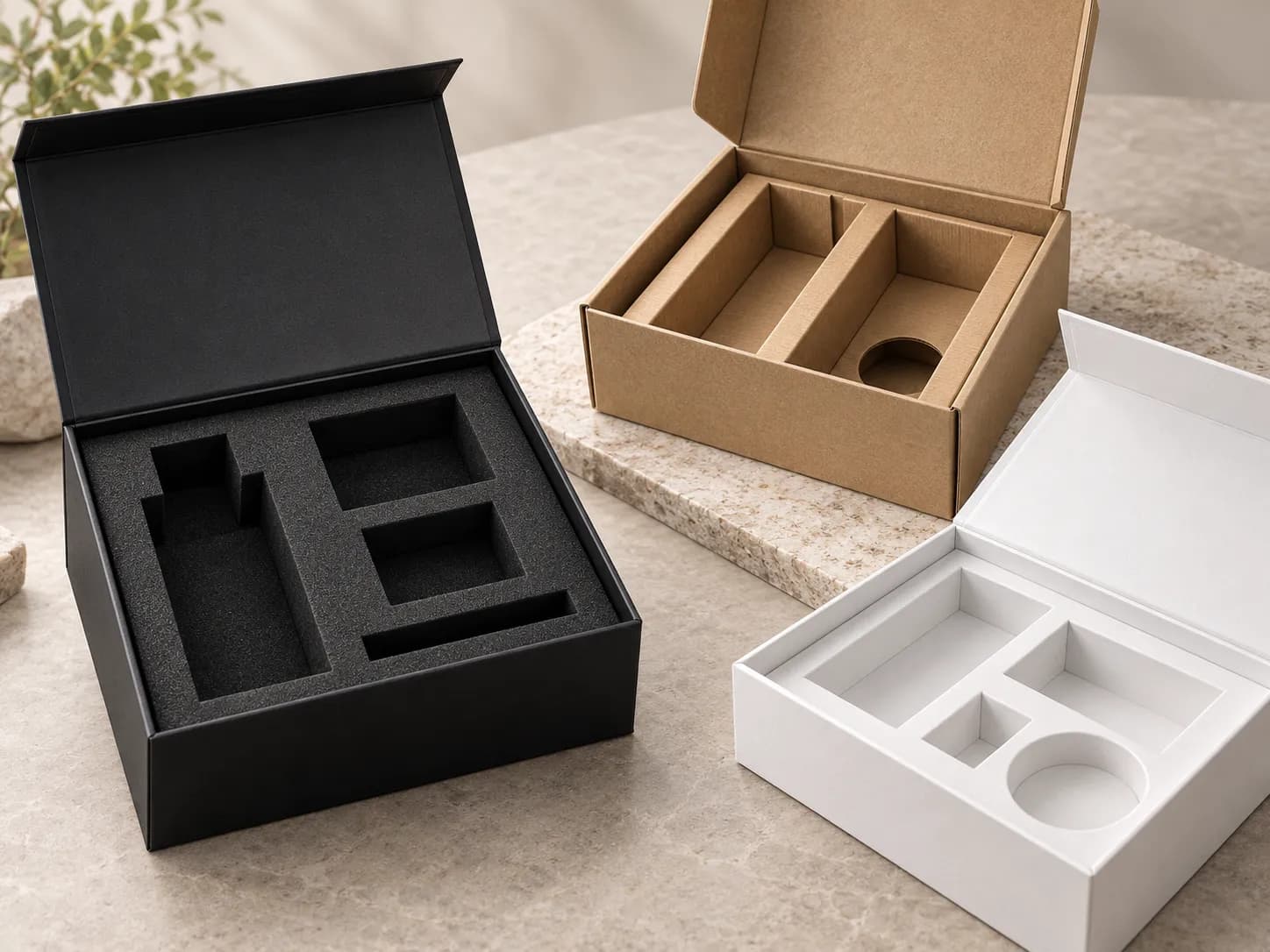
Whether an insert is part of the job and, if so, the material — board, foam, molded pulp or fabric-wrapped. An RFQ that omits the insert will produce a quote you cannot use.
8. Quantity, plus the next break
Ask for your target quantity and the next step up. It costs the supplier almost nothing to provide and it tells you where your cost curve flattens.
9. Delivery address and site constraints
Freight is part of the landed cost. Note anything unusual: no loading dock, residential address, limited access hours, or a need to split deliveries.
10. Artwork status
Say plainly where you are: print-ready artwork on a supplied dieline, a design that needs adapting, or a logo and nothing else. This affects both cost and schedule, and hiding it helps nobody.
Four things worth asking for in return
An RFQ is also a set of questions. Include these and the responses become far more useful:
- The quote split into setup and per-piece, so you can see what a reorder avoids.
- The delivered cost to your address, plus the pallet count.
- The overrun and underrun tolerance.
- What sample will be provided before production, and whether it is made on the specified board and process.
A structure you can copy
Keep it to one page. Suppliers quote faster from a clear brief than from a long one.
- Product: what it is, weight, units per box.
- Box: construction, internal dimensions L x W x D.
- Material: board type and caliper, or the requirement it must meet.
- Print: method if specified, colors or named Pantones, inside print yes/no.
- Finishes: each one, with the area it applies to.
- Insert: material, or none.
- Quantity: target, and next break.
- Delivery: address, site constraints, required-by date if any.
- Artwork: current status, and whether a dieline is needed.
- Please provide: setup/per-piece split, delivered cost, pallet count, tolerance, sample description, reorder price.
What not to put in
- A target price. It anchors the response and discourages a supplier from proposing a better specification.
- A competitor's quote. You want an independent answer to compare, not a number shaded to beat one.
- Vague quality language. "Premium feel" means nothing quotable. "Matte lamination with a foil-stamped logo on the lid" does.
- An artificial deadline. Rush is a real cost in manufacturing; use it when it is true.
The short version
Ten inputs, four questions back, one page, identical to every supplier. Do that and the quotes you receive will be comparable and the box you approve will be the box that arrives.
Send your RFQ — or if you are still assembling it, ask Sophie which construction suits what you are packing and work back from there.
Terms used in this guide
- RFQ
- Request for quotation: the document a buyer sends suppliers to price a job. A packaging RFQ that can be answered accurately states dimensions, construction, board, print, finishes, quantities and the delivery destination.
- Internal dimensions
- The usable space inside a finished box, always quoted length x width x depth. Packaging is specified by internal dimensions because that is what the product has to fit into; external dimensions vary with board thickness.
- Caliper
- The thickness of a board, quoted in the US in points (pt), where one point is one thousandth of an inch. A 24pt board is 0.024 inches thick. Caliper is how paperboard is specified; GSM is a weight measure and not interchangeable with it.
- Dieline
- The flat technical drawing of a box before it is folded, showing every cut, crease, fold and glue area for that exact size and construction. Packaging artwork is built on the dieline supplied for the job — it cannot be drawn from dimensions alone.
- Pantone
- A standardized color matching system in which each color has a number and a mixed ink formula. Specifying a Pantone color is how a brand color is held consistent between print runs, rather than relying on a CMYK build.
- Overrun and underrun
- The industry practice of delivering slightly more or fewer units than ordered, because press setup consumes material and output cannot be hit exactly. The accepted tolerance is stated by the supplier and appears on the quote.
Questions
Related questions.
Anything not covered here, put it in the notes on your quote and we will answer it directly.
Ask on your quoteWhat if I don't know which construction I need?
Say so in the RFQ and describe how the box will be opened, displayed and shipped, plus the product's weight and how it is sold. A packaging supplier can recommend a construction from that — just make sure every supplier is working from the same description so the recommendations are comparable.
Should I include my budget in a packaging RFQ?
Generally no. A stated budget anchors the response and can discourage a supplier from proposing a specification change that would serve you better. Ask for the cost of the specification you have described, then discuss alternatives.
Do I need artwork ready to request a quote?
No, but you do need to say what stage you are at. Print-ready artwork on a dieline, a design that needs adapting, and a logo alone are three different amounts of prepress work, and they affect cost and schedule differently.
How specific do finish requests need to be?
Specific enough to price. Name the finish and the area it covers — "soft-touch matte lamination overall, foil-stamped logo on the lid, approximately two square inches" is quotable. "Premium finish" is not.
Keep reading
Related guides.
Packaging covered in this guide
Put it into a quote.
Start here
Send us your dimensions. We’ll send back a box.
Or talk to a packaging specialist: (209) 444-0744