Wholesale & Bulk Packaging · 7 min read
Custom inserts for bulk packaging orders
The insert is what turns a box into packaging. At volume it is also a second product with its own tooling, material and assembly — here is how to choose one that protects the product without doubling the cost.
The short answer
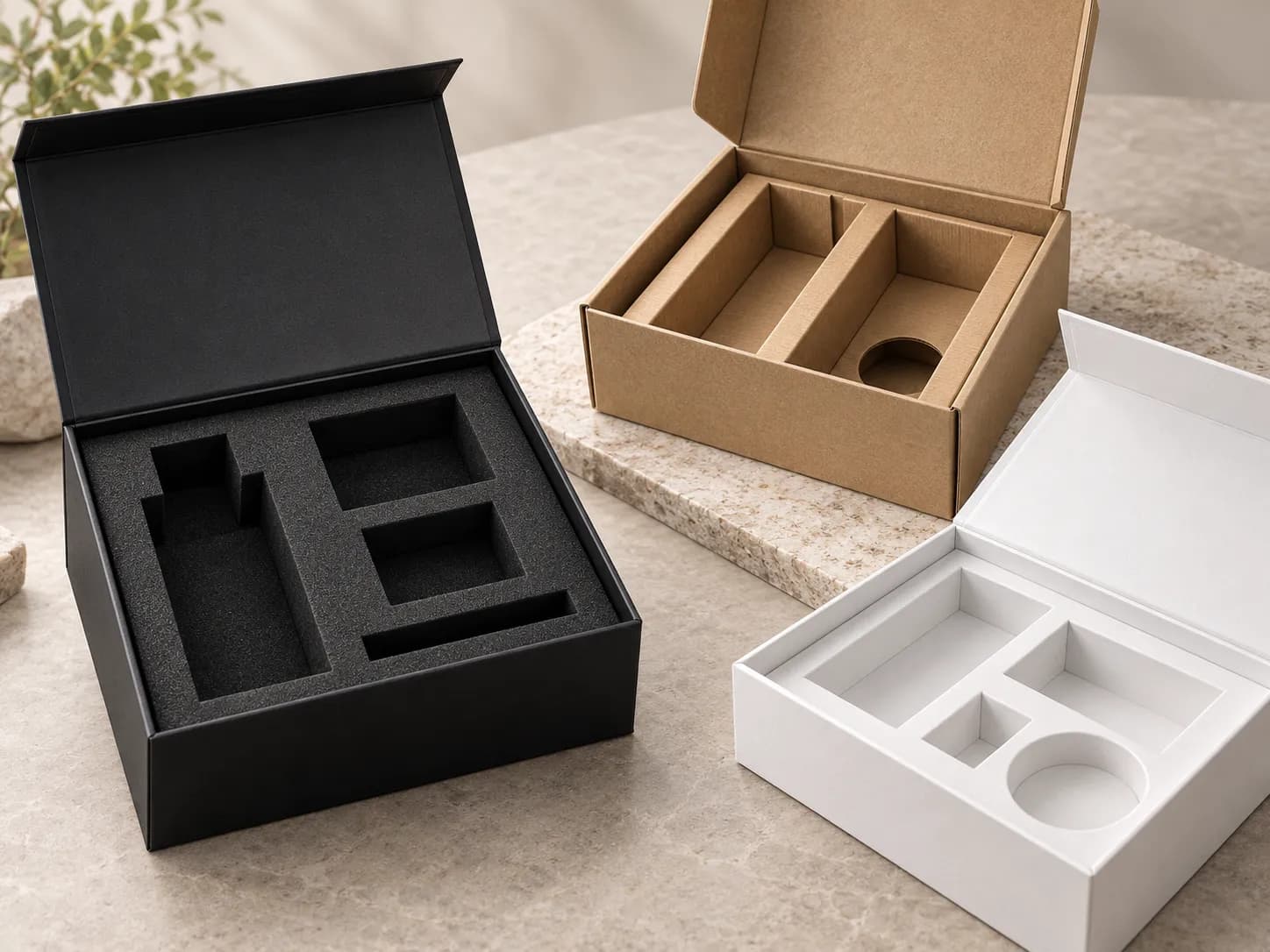
A packaging insert holds the product still inside the box, which is what separates packaging from a container. At bulk quantities the four common materials behave very differently: die-cut board is the most economical and suits flat or regular products, foam grips heavier and fragile items, molded pulp suits curved shapes and a paper-based look, and fabric-wrapped trays are the most expensive and the most deliberate. The insert sets the internal dimensions, so it must be designed with the box rather than added afterwards.
Custom box inserts explained covers what each insert material does. This guide covers what changes when you are ordering thousands of them, because at volume an insert is not an accessory — it is a second product with its own material cost, its own tooling and its own assembly time.
Why the insert earns its cost
An insert does three jobs at once, and at volume each has a measurable value:
- It stops breakage. Replacing a broken product costs the product, the packaging, the shipping and often the customer.
- It removes void fill. Loose fill is material, labor and a worse unboxing.
- It lets the box be smaller. A product held in place needs less clearance, and a smaller box costs less to make and less to ship — see reducing dimensional weight costs.
That third point is the one most often missed. The insert frequently pays for itself in freight rather than in packaging.
The four materials at volume
| Material | Holds | Presentation | Volume considerations |
|---|---|---|---|
| Die-cut board | Flat and regular products, multi-packs | Clean, can be printed | Lowest material cost; nests flat; fast to produce |
| Foam (die-cut or routed) | Heavy, fragile, irregular items | Recessive, technical | Higher material cost; bulky to ship and store |
| Molded pulp | Curved and contoured products | Matte, fibrous, paper-based | Needs its own mold; economical once tooled |
| Fabric-wrapped tray | Jewelry, fragrance, high-value items | The most deliberate reveal | Highest cost; most hand assembly |
Die-cut board
The default at volume, and correctly so. A die-cut board platform, divider set or folded tray is inexpensive, nests flat in transit and storage, can be printed, and handles a surprising range of products. For most e-commerce and retail packaging it is the right answer.
Foam
Foam grips. It is the right choice when the product is heavy enough to develop momentum in transit, or fragile enough that a board platform will not absorb a drop. The costs at volume are material and bulk: foam inserts do not nest, so they take space in transit and storage.
Molded pulp
Molded pulp is formed by pressing paper fiber into a mold. It suits curved and contoured products that a flat board platform cannot hold, and it gives a matte, fibrous, paper-based appearance. It requires its own mold, which is a tooling cost, so it becomes economical at volume rather than on a first run.
Fabric-wrapped
A rigid tray wrapped in fabric or a specialty material, usually with a recess cut for the product. This is a presentation decision rather than a protection one, used where the reveal is the point — jewelry, fragrance, high-value gifting. It carries the most hand assembly and the highest unit cost.
Design the insert and the box together
This is the most common and most expensive sequencing error in packaging. The insert sets the internal dimensions the box must have. Specify the box first and the insert afterwards and you will either get an insert that does not fit or a box that is bigger than it needed to be.
- Measure the product — see how to measure your product.
- Decide how it should be held and presented when the box opens.
- Design the insert to do that.
- Derive the box internal dimensions from the insert, plus clearance.
- Quote both together, from the same supplier, as one specification.
Controlling insert cost at volume
- Try board first. Ask whether a die-cut board insert would hold the product adequately before accepting foam.
- Reduce the part count. One folded board piece that does the job of three separate components saves material and assembly.
- Design for assembly. An insert that only fits one way, and obviously so, is faster to pack and harder to get wrong.
- Share across SKUs. Variants of similar size can often share one insert, which shares the tooling.
- Check it nests. Inserts that stack flat cost far less to ship and store than ones that do not.
What to test on the sample
- Put the real product in it — not a stand-in, and not a photograph.
- Close the box and shake it. Movement now is breakage later.
- Check the product can be taken out easily. An insert that grips too hard is a bad unboxing and sometimes a damaged product.
- Check it seats flat in the box with no bowing.
- If it ships, post one to yourself packed as a customer would receive it.
The short version
Start with die-cut board and justify anything more expensive. Design the insert before the box, not after. Quote them together. And remember that the insert often pays for itself by letting you ship a smaller parcel rather than by any saving on the packaging line itself.
Send your product dimensions and quantity and ask for the box and insert quoted as one specification.
Terms used in this guide
- Insert
- A fitted component inside a box that holds the product still — board dividers, a die-cut foam pad, molded pulp or a fabric-wrapped tray. The insert sets the internal dimensions, so it is designed together with the box rather than afterwards.
- Molded pulp
- An insert or tray formed by pressing paper pulp into a mold and drying it. It suits curved or irregular products and gives a matte, fibrous paper-based finish.
- Die-cut
- Cut to a shape using a die rather than trimmed square — how box blanks, windows, handles and board inserts are produced.
- Void fill
- Material added to take up empty space in a shipping box so the contents cannot move. A correctly sized box and a fitted insert reduce the need for it, and reduce dimensional weight at the same time.
- Internal dimensions
- The usable space inside a finished box, always quoted length x width x depth. Packaging is specified by internal dimensions because that is what the product has to fit into; external dimensions vary with board thickness.
Questions
Related questions.
Anything not covered here, put it in the notes on your quote and we will answer it directly.
Ask on your quoteIs a board insert strong enough for a fragile product?
Often, yes — a well-designed die-cut board platform that suspends the product and stops it moving can protect very effectively. Foam becomes the right answer when the product is heavy enough to build momentum in a drop or has a shape board cannot hold securely.
Do inserts add much to the cost at volume?
They add a real material and assembly cost, but they frequently save more than they cost by reducing breakage and allowing a smaller box — which reduces both packaging material and the dimensional weight you are billed on every shipment.
Can I add an insert to packaging I already have?
You can, but it is a compromise. The insert has to fit the existing internal dimensions rather than the box being sized around the insert, which usually means more empty space than necessary. Redesigning both together is better when the volume justifies new tooling.
Which insert material is most sustainable?
Paper-based options — die-cut board and molded pulp — are generally the easier ones for a customer to recycle with paper packaging. Beyond that, the honest answer depends on your local recycling streams and on the specific materials used, so ask your supplier what the insert is made of rather than relying on a general claim.
Keep reading
Related guides.
Packaging covered in this guide
Put it into a quote.
Start here
Send us your dimensions. We’ll send back a box.
Or talk to a packaging specialist: (209) 444-0744