E-commerce & Shipping · 7 min read
How brands can reduce dimensional-weight shipping costs
Carriers bill on the space a parcel occupies as well as its weight. Packaging decisions made once end up on every shipping invoice — here is how to stop paying to ship air.

The short answer
Dimensional weight is a billing weight carriers calculate from a parcel's volume, and they charge whichever is greater, the actual weight or the dimensional one. A box larger than the product needs therefore raises the shipping cost on every order, regardless of what is inside. The ways to reduce it are to size boxes to the product rather than to convenience, hold the product with a fitted insert instead of void fill, stock a small range of sizes that match real order profiles, and reduce box height, which is usually the most wasted dimension.
Packaging appears on one invoice. Shipping appears on every invoice. And the box you chose is one of the biggest factors in what the shipping invoice says — which makes packaging sizing one of the highest-leverage decisions an e-commerce brand makes.
What dimensional weight is
Dimensional weight — also called DIM weight or volumetric weight — is a billing weight derived from a parcel's volume rather than what it actually weighs. Carriers compare it against the actual weight and charge on whichever is greater.
The logic is straightforward from the carrier's side: a trailer fills up on space long before it fills up on weight. A large box full of light product occupies capacity that could have carried something else, so it is billed accordingly.
The consequence for a brand is that an oversized box costs money on every single order, whether or not anything heavy is inside it. Carriers publish their own formulas and divisors, and those change, so take the current numbers from your own carrier agreement rather than from any general guide.
Where the waste usually is
Height
Height is the most commonly wasted dimension, because brands size the footprint to the product and then leave generous headroom "just in case". Volume is length times width times depth — so a box an inch taller than it needs to be is pure billed volume on every shipment.
One box for everything
Stocking a single box size is operationally simple and expensive. If one size has to accommodate your largest order, every smaller order ships in a box that is mostly air.
Void fill standing in for structure
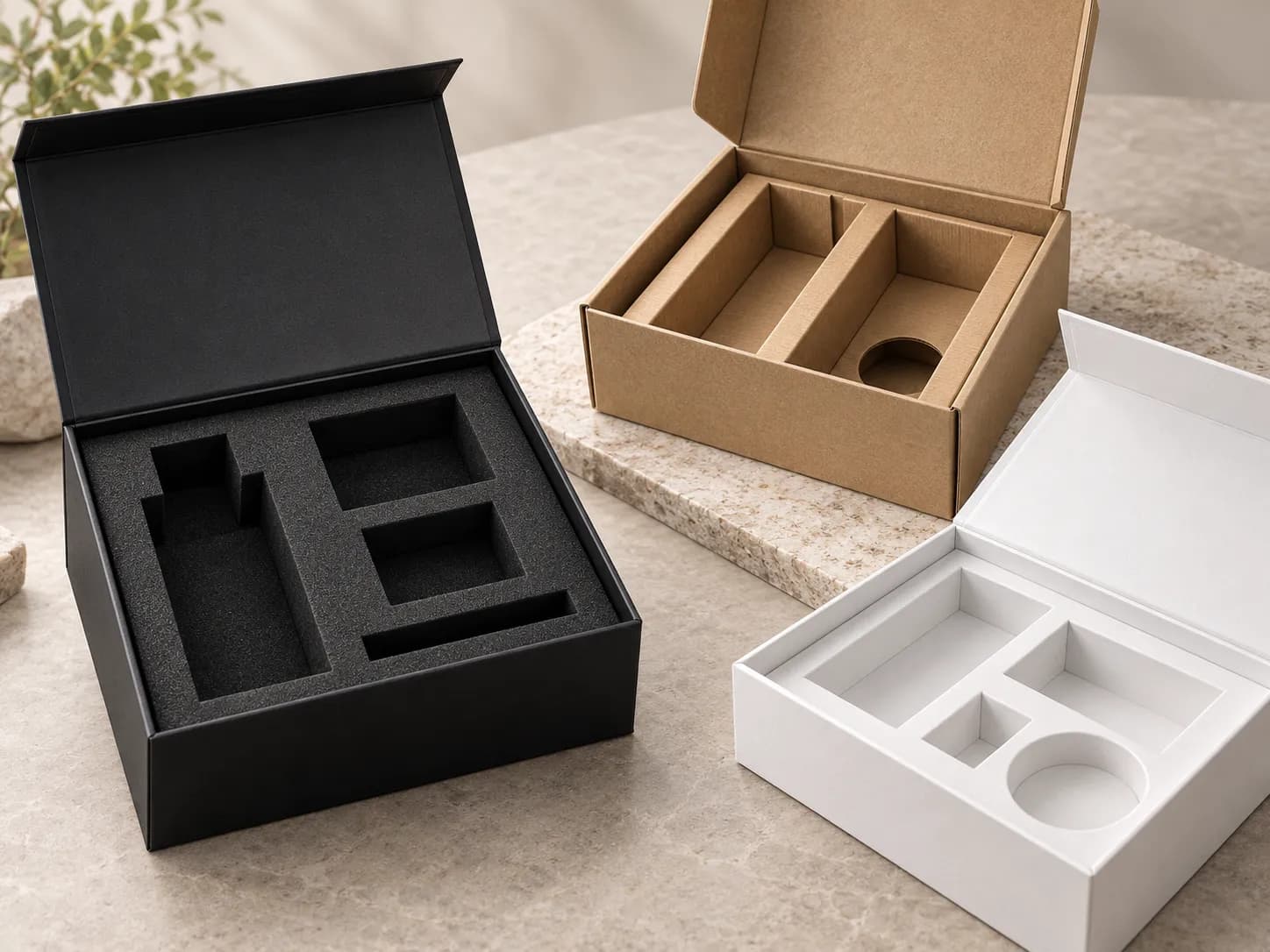
If you are filling a lot of space with void fill, you are paying to ship that space and paying for the filler. A fitted insert lets you use a smaller box instead.
Clearance that was never checked
Boxes are often specified with clearance nobody measured. A properly derived internal dimension — product, plus insert, plus the minimum the construction needs — is usually smaller than the inherited one.
How to reduce it
- Measure your actual orders. Take your top order configurations by volume and record the real dimensions of the contents. Most brands find two or three shapes cover the large majority of shipments.
- Size boxes to those profiles, not to the largest possible order.
- Attack height first. It is usually where the easiest reduction is, and it is the dimension people are least precise about.
- Replace void fill with a fitted insert. It presents better, protects better and lets the box shrink — see custom inserts for bulk orders.
- Stock a small range of sizes. Two or three well-chosen sizes usually beat one universal box, even accounting for the extra stockholding.
- Check the flute grade. A thicker flute makes the finished box slightly bulkier; if the contents do not need it, E-flute keeps the profile slimmer — see E-flute vs B-flute.
- Reconsider the outer. A product in a retail carton inside a mailer is two boxes of clearance. Sometimes the mailer can be the only box.
Internal versus external
Packaging is specified by internal dimensions, because that is what the product has to fit into. Carriers bill on external dimensions, because that is what occupies the trailer.
The gap between them is the board thickness, which is small per wall but real once it is counted on all six sides. When you are close to a carrier threshold, confirm the external dimensions of the finished box rather than assuming them from the internal specification.
What not to sacrifice
Shrinking the box is only a saving if the product still arrives intact:
- Keep enough clearance that the product is not under pressure in the closed box.
- Keep the protection the journey requires — breakage costs far more than dimensional weight.
- Keep the unboxing worth having. A box crammed to the edges is cheaper to ship and worse to receive.
- Keep the box easy to pack. If it takes twice as long to fill, you have moved the cost rather than removed it.
The short version
Carriers bill on volume as well as weight, so an oversized box is a recurring cost on every order. Measure your real order profiles, size two or three boxes to them, cut height first, and use a fitted insert instead of void fill. It is a packaging decision that pays out on the shipping invoice.
Send your real product dimensions rather than the size of the box you use now, and ask for the external dimensions of the finished box.
Terms used in this guide
- Dimensional weight
- A billing weight carriers calculate from a parcel's volume rather than its actual weight, charging whichever is greater. A box larger than the product needs therefore raises the shipping cost even when nothing heavy is inside it.
- Void fill
- Material added to take up empty space in a shipping box so the contents cannot move. A correctly sized box and a fitted insert reduce the need for it, and reduce dimensional weight at the same time.
- External dimensions
- The outside measurements of a finished box, including board thickness. They matter for shipping, cartonization and shelf or pallet fit, but a box is specified by its internal dimensions.
- Internal dimensions
- The usable space inside a finished box, always quoted length x width x depth. Packaging is specified by internal dimensions because that is what the product has to fit into; external dimensions vary with board thickness.
- Mailer box
- A corrugated box with an integrated lid and side wings that fold into place without tape, designed to survive a courier network on its own. Widely used for e-commerce because it opens cleanly and can be printed inside and out.
Questions
Related questions.
Anything not covered here, put it in the notes on your quote and we will answer it directly.
Ask on your quoteWhat is dimensional weight?
A billing weight that carriers calculate from a parcel's volume rather than its actual weight. They compare the two and charge on whichever is greater, because trailer space runs out before weight capacity does.
How do I calculate dimensional weight for my parcels?
Carriers publish their own formulas and divisors, and those vary by carrier, service and agreement. Take the current figures from your own carrier contract and apply them to the external dimensions of your finished box.
Is it better to have one box size or several?
Several, usually. One universal box has to fit your largest order, so every smaller shipment carries billed empty space. Two or three sizes matched to your real order profiles typically save more than the extra stockholding costs.
Does a fitted insert really reduce shipping cost?
Indirectly but meaningfully. Holding the product in place means less clearance is needed, which allows a smaller box, which reduces the billed volume on every shipment — and it usually replaces void fill you were buying separately.
Keep reading
Related guides.
Packaging covered in this guide
Put it into a quote.
Materials, finishes and industries in this guide
Start here
Send us your dimensions. We’ll send back a box.
Or talk to a packaging specialist: (209) 444-0744