Wholesale & Bulk Packaging · 8 min read
Wholesale rigid boxes for luxury brands
Rigid boxes carry weight, hard edges and a lid that resists — and they cost more in material, labor and freight. What changes when you buy them in the thousands, and how to protect the feel while controlling the cost.
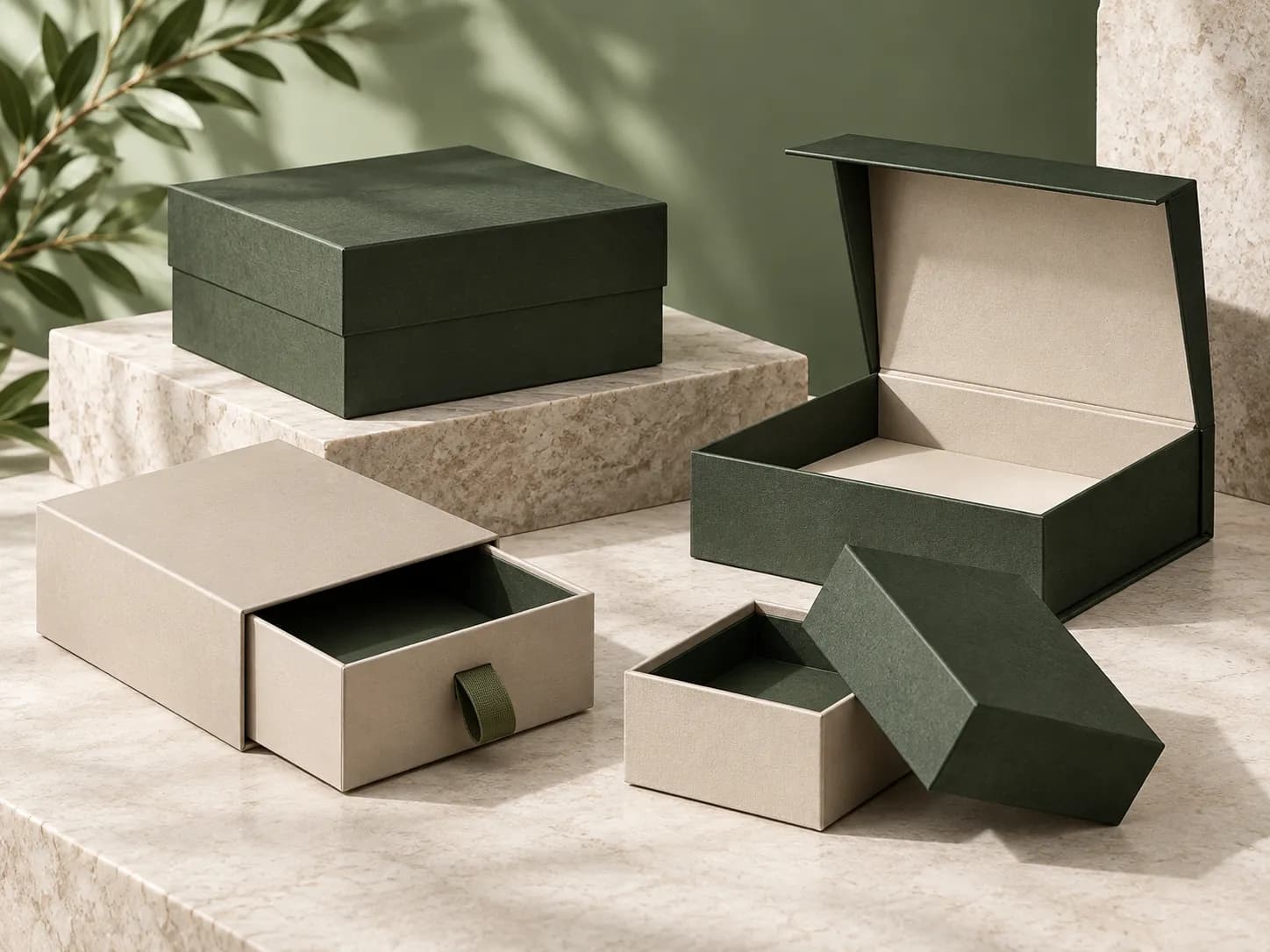
The short answer
A rigid box is built from thick greyboard panels that are cut, glued into shape and wrapped in printed or specialty paper, so it arrives assembled and holds its shape under weight. Buying at wholesale volume, the main cost drivers are the hand assembly involved, the wrap material and finishes, and the freight and storage taken up by boxes that ship already made. The most effective lever is construction: a collapsible design ships flat while keeping the rigid hand-feel.
A rigid box is the format brands reach for when the packaging is part of the product experience. It has weight in the hand, a hard square edge, and a lid that lifts with resistance rather than flapping open. None of that is decoration — it is what the construction does.
It is also the most expensive custom construction per unit, and the one whose costs behave least like a folding carton's. Buying in the thousands means understanding where the money goes.
How a rigid box is built
Thick greyboard is cut into panels and assembled into a shell. A separately printed wrap — paper, specialty stock or textured material — is then laminated over the shell and turned in at the edges. All printing and finishing happens on the wrap before it is applied; the structural board is never printed directly.
That two-stage construction is why rigid boxes cost more: more material, more process steps, and significantly more hand work than a carton that folds itself.
The constructions worth knowing
| Construction | How it opens | Typically used for |
|---|---|---|
| Two-piece | Separate lid lifts off a base | Apparel, gifting, jewelry sets |
| Magnetic closure | Hinged lid held by concealed magnets | Premium electronics, subscription, gifting |
| Drawer | Inner tray slides from an outer sleeve | Slow reveal — fragrance, confectionery, jewelry |
| Collapsible | Magnetically held panels, erected at packing | High volume where freight matters |
| Sleeve and tray | Printed sleeve over a rigid tray | Ranges sharing one inner specification |
Where the cost actually sits at volume
Hand assembly
Rigid boxes involve substantially more manual work than cartons, and that labor content does not fall away with volume the way setup does. It is the main reason the rigid unit cost flattens earlier than a carton's.
The wrap and its finishes
The wrap is where the brand lives, and where specification creeps. Specialty papers with texture, soft-touch lamination, foil stamping and embossing all sit here. Each is a pass; each is paid on every box.
A useful discipline at volume: pick one hero finish and execute it properly rather than layering three. A single well-registered foil emboss on a textured uncoated wrap reads as more considered than foil plus spot UV plus a second color.
Freight and storage
This is the cost that surprises people. A conventional rigid box ships assembled, so you are paying to move and store air from the moment it leaves the plant. At a few hundred units that is a rounding error. At several thousand it is pallets.
The biggest lever: collapsible construction
A collapsible rigid box has hinged panels held by concealed magnets. It ships flat and is erected at packing, while retaining the greyboard thickness and the hard edge that make a rigid box feel like one.
At wholesale volume this frequently outweighs every other saving available, because it reduces both freight and warehouse footprint on every consignment. Collapsible rigid boxes for high-volume orders covers where it works and the trade-offs.
Inserts are part of the product
In premium packaging the insert does as much work as the box. It holds the product at the angle you want it seen, it creates the pause before the reveal, and it stops movement in transit.
At volume, the material choice matters commercially: die-cut board is the most economical and works well for flat or regular products; foam grips heavier or fragile items; molded pulp suits curved shapes and a paper-based look; fabric-wrapped trays are the most expensive and the most deliberate. Custom inserts for bulk orders compares them.
Protecting the feel while controlling the cost
- Keep the board thickness. It is what the customer feels. Thin the wrap specification before you thin the shell.
- One hero finish, executed well, rather than three competing ones.
- Use a sleeve if you have several variants — one rigid inner, several printed sleeves.
- Size it honestly. A rigid box with too much empty space reads as wasteful rather than generous, and costs more in board and freight.
- Consider collapsible before you consider cheaper materials.
Before a wholesale rigid order
- Approve a pre-production sample on the real wrap and board. Rigid boxes are tactile products; a rendering proves nothing.
- Check the lid fit — too tight and it is hard to open, too loose and it feels cheap. This is what sampling is for.
- Confirm color on the actual wrap stock. Uncoated and textured stocks shift color noticeably.
- Get the pallet count. Assembled rigid boxes take far more space than people expect.
- Confirm the reorder price and whether tooling is held.
The short version
Rigid boxes cost more because of material, hand assembly and the space they occupy. At volume, the construction — especially collapsible versus fixed — moves the number more than any material substitution. Protect the board thickness and the single finish that carries the brand, and control cost everywhere else.
Request a rigid box quote at your quantity, and ask for a collapsible option alongside it so you can compare the delivered cost.
Terms used in this guide
- Rigid box
- A box built from thick chipboard or greyboard panels that are cut, glued into shape and wrapped in a printed or specialty paper. It arrives assembled rather than flat, holds its shape under weight and has a hard, square edge. Also called a set-up box.
- Greyboard
- Dense, rigid board made from recycled fiber, used as the structural core of a rigid box. It is not printed on directly — a printed wrap is laminated over it.
- Wrap
- The printed or specialty paper laminated over the greyboard shell of a rigid box. All printing and finishing for a rigid box happens on the wrap before it is applied, not on the structural board.
- Two-piece box
- A rigid box made of a separate base and a lid that fits over it. The lid may cover the full depth of the base (a full telescoping box) or only part of it. Common for apparel, gifting and jewelry.
- Drawer box
- A rigid box with an inner tray that slides out of an outer sleeve, usually with a ribbon or thumb cut as the pull. The sliding action gives a slow, controlled reveal, which is why it is used for premium and gift packaging.
- Collapsible rigid box
- A rigid box whose panels are hinged and held closed by magnets or elastic so it can ship flat and be assembled at packing. It gives the weight and hard edge of a rigid box while taking far less space in transit and storage.
Questions
Related questions.
Anything not covered here, put it in the notes on your quote and we will answer it directly.
Ask on your quoteWhy are rigid boxes more expensive than folding cartons?
More material, and considerably more process. A rigid box is built from thick greyboard panels and then wrapped in a separately printed paper, much of it by hand, whereas a folding carton is cut, creased and glued from a single printed sheet and folds itself.
Do rigid boxes get much cheaper at high volume?
Less dramatically than cartons. The fixed setup is spread thinner as with any job, but the hand assembly and material content remain per-unit costs that volume does not reduce much. Structural changes such as collapsible construction usually save more than quantity does.
Can rigid boxes ship flat?
Collapsible rigid boxes can — hinged panels held by concealed magnets are erected at packing. Conventional rigid boxes are delivered assembled, which is why freight and storage are a larger part of their landed cost.
What finishes work best on rigid boxes?
Anything applied to the wrap, which is all of them. Soft-touch lamination, foil stamping and embossing are the most commonly specified because they reinforce what the construction already communicates. Specify one hero finish rather than layering several.
Keep reading
Related guides.
Packaging covered in this guide
Put it into a quote.

Materials, finishes and industries in this guide
Start here
Send us your dimensions. We’ll send back a box.
Or talk to a packaging specialist: (209) 444-0744