Box Styles & Construction · 7 min read
Rigid boxes vs folding cartons at 1,000+ units
The rigid-versus-carton choice looks different once quantity is real. How the two cost curves diverge, what freight does to the comparison, and the middle-ground options most brands overlook.
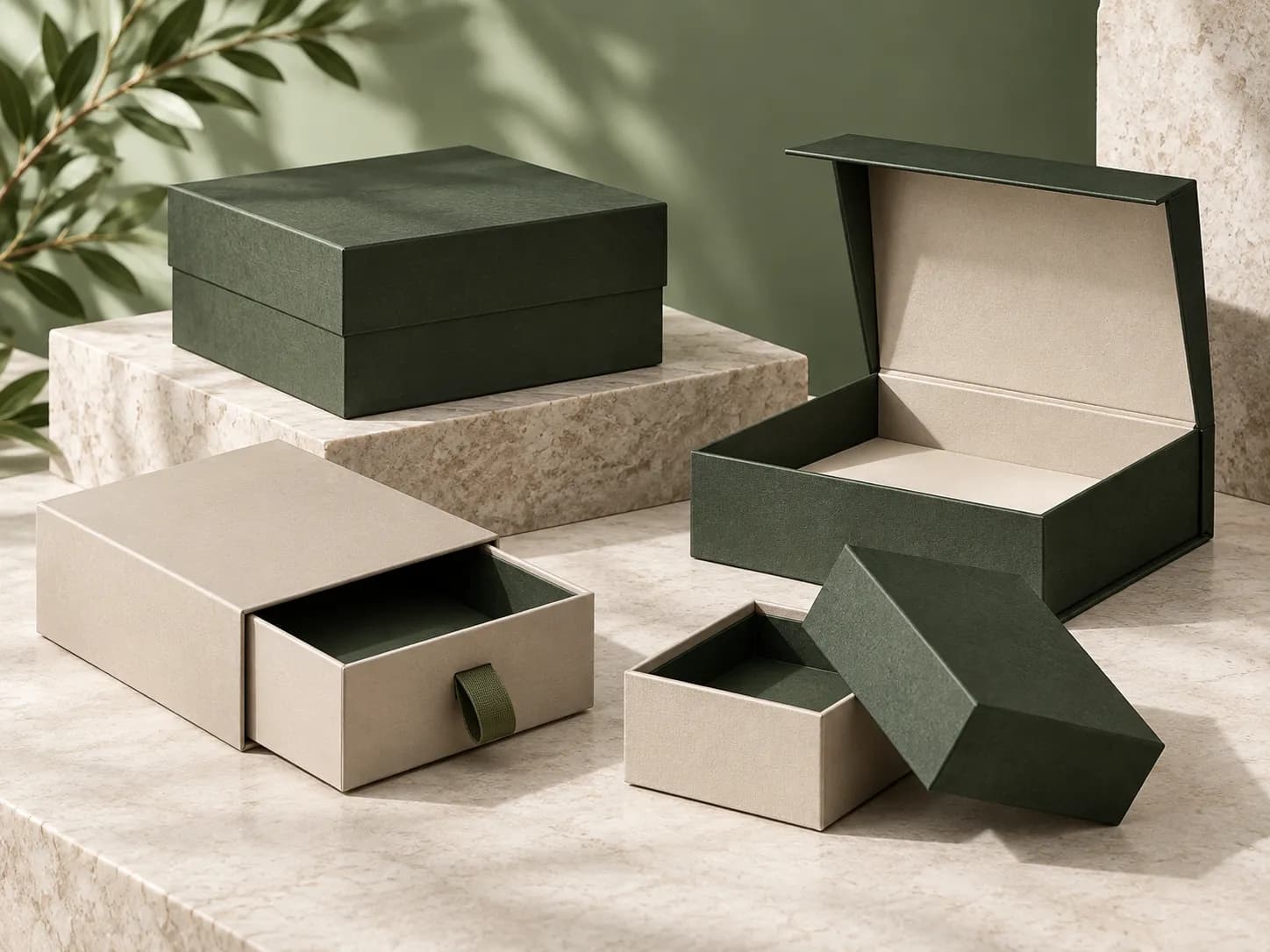
The short answer
At low quantities rigid boxes and folding cartons are both dominated by setup cost, so the gap between them looks smaller than it is. As quantity rises the carton's cost falls faster, because it is mostly material and machine time, while the rigid box retains substantial hand assembly and ships assembled rather than flat. At 1,000 units and above the honest comparison is delivered cost including freight and storage, and the middle-ground options — heavy-caliper cartons and collapsible rigid boxes — often resolve the decision.
Rigid boxes vs folding cartons covers the decision on its merits: construction, feel, price point and how the product reaches the customer. This guide covers what changes when the quantity is real, because the economics of the two formats diverge as the run gets longer.
Why the gap widens with volume
Both constructions carry a fixed setup cost that gets spread thinner as quantity rises. But what remains underneath is very different.
A folding carton, once set up, is mostly machine time and board. Sheets run fast, the blank is die-cut and glued in line, and the carton folds itself at packing. As quantity rises, the per-unit cost approaches the cost of the material plus a modest amount of press time.
A rigid box, once set up, still involves cutting greyboard panels, assembling a shell, printing and finishing a separate wrap, and laminating that wrap on — much of it by hand. That labor is a per-unit cost. It does not amortize.
| Folding carton | Rigid box | |
|---|---|---|
| Dominant cost at low volume | Setup | Setup |
| Dominant cost at high volume | Board and press time | Hand assembly and wrap |
| Effect of more volume | Unit cost falls substantially | Unit cost falls, then flattens early |
| Ships | Flat | Assembled, unless collapsible |
| Freight per unit at volume | Low | High |
| Storage footprint | Small | Large |
Freight and storage change the answer
At a few hundred units, freight is a line you glance at. At several thousand, it is a decision input. A thousand flat cartons and a thousand assembled rigid boxes are not remotely the same consignment — the rigid boxes occupy many times the volume, which means more pallets, more truck space and more warehouse positions.
This is why the only honest comparison at volume is delivered cost per unit, including freight, and ideally including some estimate of what the storage costs you. A rigid quote that looks close to a carton quote ex-works may not be close at all once the pallets are counted.
The middle ground most brands overlook
The decision is usually presented as binary. It is not. Two constructions sit between the extremes and frequently resolve the trade-off:
A heavy-caliper carton with structure
A folding carton on a heavier caliper board, with an auto-lock bottom, soft-touch lamination and a die-cut insert, delivers a great deal of a rigid box's presence at carton economics — and still ships flat. It will not have the hard square edge or the weight, but for many products that is not what is being bought.
A collapsible rigid box
A collapsible rigid box keeps the greyboard thickness and the hard edge but ships flat and is erected at packing. It resolves the freight and storage problem without giving up the construction. See collapsible rigid boxes for high-volume orders.
How to make the decision at volume
- Decide what the box has to do: protect, display, be kept, be shipped alone, or carry the brand at the moment of opening.
- Get both quoted at your real quantity, delivered to your address, with the insert included in each.
- Ask for the pallet count for each, and price the storage.
- Ask for a collapsible rigid quote alongside the fixed rigid one.
- Ask for a heavy-caliper carton option alongside the standard one.
- Sample the two shortlisted options and put them in someone's hands. This decision is tactile; it should not be made from a spreadsheet alone.
When rigid is still the right answer
- The box will be kept — jewelry, fragrance, a gift that stays on a shelf.
- The product is heavy or glass, and the box has to hold its shape.
- The unboxing is the marketing, and the weight in the hand is doing work a photograph cannot.
- The product sits at a price point where the packaging cost is a small proportion of the sale.
The short version
The carton's cost falls faster with volume because it is mostly material and machine time; the rigid box's flattens earlier because it carries real hand labor and ships assembled. Compare delivered cost including freight, and put collapsible rigid and heavy-caliper cartons on the table before you decide.
Ask for both constructions quoted side by side at your quantity, delivered — it is the only comparison that means anything at volume.
Terms used in this guide
- Rigid box
- A box built from thick chipboard or greyboard panels that are cut, glued into shape and wrapped in a printed or specialty paper. It arrives assembled rather than flat, holds its shape under weight and has a hard, square edge. Also called a set-up box.
- Folding carton
- A box die-cut from a single sheet of paperboard, scored along its fold lines and glued at one seam. It ships flat and is erected at packing. Printing goes directly onto the board, which makes it the most common construction for retail products.
- Collapsible rigid box
- A rigid box whose panels are hinged and held closed by magnets or elastic so it can ship flat and be assembled at packing. It gives the weight and hard edge of a rigid box while taking far less space in transit and storage.
- Greyboard
- Dense, rigid board made from recycled fiber, used as the structural core of a rigid box. It is not printed on directly — a printed wrap is laminated over it.
- Caliper
- The thickness of a board, quoted in the US in points (pt), where one point is one thousandth of an inch. A 24pt board is 0.024 inches thick. Caliper is how paperboard is specified; GSM is a weight measure and not interchangeable with it.
- Auto-lock bottom
- A folding-carton base whose glued flaps lock into a flat bottom as the carton is squared up, with no assembly beyond opening it. It is chosen for heavier products and for faster hand packing.
Questions
Related questions.
Anything not covered here, put it in the notes on your quote and we will answer it directly.
Ask on your quoteAt what quantity does a folding carton become clearly cheaper than a rigid box?
There is no single crossover, because it depends on the size, the finishes and the freight distance. The carton is generally less expensive at every quantity, and the gap widens as volume rises. Get both quoted delivered at your actual quantity rather than relying on a rule of thumb.
Can a folding carton feel premium enough to replace a rigid box?
Often, yes. A heavier caliper board, an auto-lock bottom, soft-touch lamination, a foil detail and a fitted insert take a carton a long way. It will still be lighter in the hand, which is the one thing a carton cannot replicate.
Does freight really change the decision?
At volume it frequently does. Rigid boxes ship assembled and occupy many times the space of flat cartons, so the pallet count and the storage footprint can be a larger difference than the unit price. Always compare delivered cost.
Is a collapsible rigid box as strong as a conventional one?
It uses the same thick greyboard panels, so it has the same board strength and the same hard edge. The difference is the hinged, magnetically held construction that lets it fold flat, and the assembly step at packing that a fixed box does not need.
Keep reading
Related guides.
Packaging covered in this guide
Put it into a quote.


Start here
Send us your dimensions. We’ll send back a box.
Or talk to a packaging specialist: (209) 444-0744