Packaging Cost & Quantity · 9 min read
How much do custom boxes cost in the USA?
There is no list price for a custom box. Here is what actually sets the number, how it behaves as the quantity rises, and what to send so a quote comes back accurate the first time.
The short answer
Custom boxes are quoted per job rather than sold at a list price, because the cost is built from a fixed setup portion — dielines, printing plates, cutting dies and press make-ready — plus a per-piece portion for board, printing, finishing, assembly and freight. The setup portion is incurred once no matter how many boxes you order, so it is the single biggest reason the unit cost falls as the run gets longer. To get an accurate number you need to supply internal dimensions, construction, board, print and finish specification, quantity and the delivery destination.
It is the first question every packaging buyer asks, and the honest answer is that no supplier can give you a number until they know what you are asking them to make. A custom box is manufactured to your dimensions, on the board you specify, with your artwork, in the quantity you order. Change any one of those and the cost changes with it.
What you can know in advance — and what this guide covers — is how the number is built, which decisions move it most, and how it behaves as your order grows. Once you understand the structure, a quote stops being a mystery and becomes something you can plan against and negotiate from.
Why there is no price list for a custom box
Stock boxes have list prices because they already exist: they were made in advance, in one size, and sit on a shelf. A custom box does not exist until your job runs. Before a single box is produced, someone has to draw a dieline for your exact size and construction, make or select a cutting die, prepare your artwork for the press, and set the press up to run it.
That work is real, it is skilled, and it costs the same whether the run is 50 boxes or 50,000. It is why custom packaging has a minimum order quantity at all, and why the first question a supplier asks is not "what is your budget" but "what are you making".
The two halves of every packaging quote
Every custom packaging price is the sum of two very different things. Separating them is the single most useful thing a buyer can do, because they behave in opposite ways as the quantity changes.
| Setup (fixed) | Per-piece (variable) | |
|---|---|---|
| What it covers | Dieline drawing, cutting die, printing plates, prepress, press make-ready | Board, ink, coatings, finishing passes, gluing, assembly, packing |
| How often it is incurred | Once per job, per specification | Once per box produced |
| Effect of ordering more | Spread thinner across every box | Broadly proportional to the count |
| Effect of reordering unchanged | Largely avoided on a repeat run | Unchanged per box |
| Effect of changing the size | Incurred again — new die, new dieline | Changes with board area used |
This is why the same box can feel expensive at one quantity and reasonable at another. Nothing about the box changed; the setup cost simply had more units to spread across.
What moves the number most
In rough order of impact, these are the decisions that change a packaging quote. Most buyers focus on the last one and underestimate the first three.
1. Construction
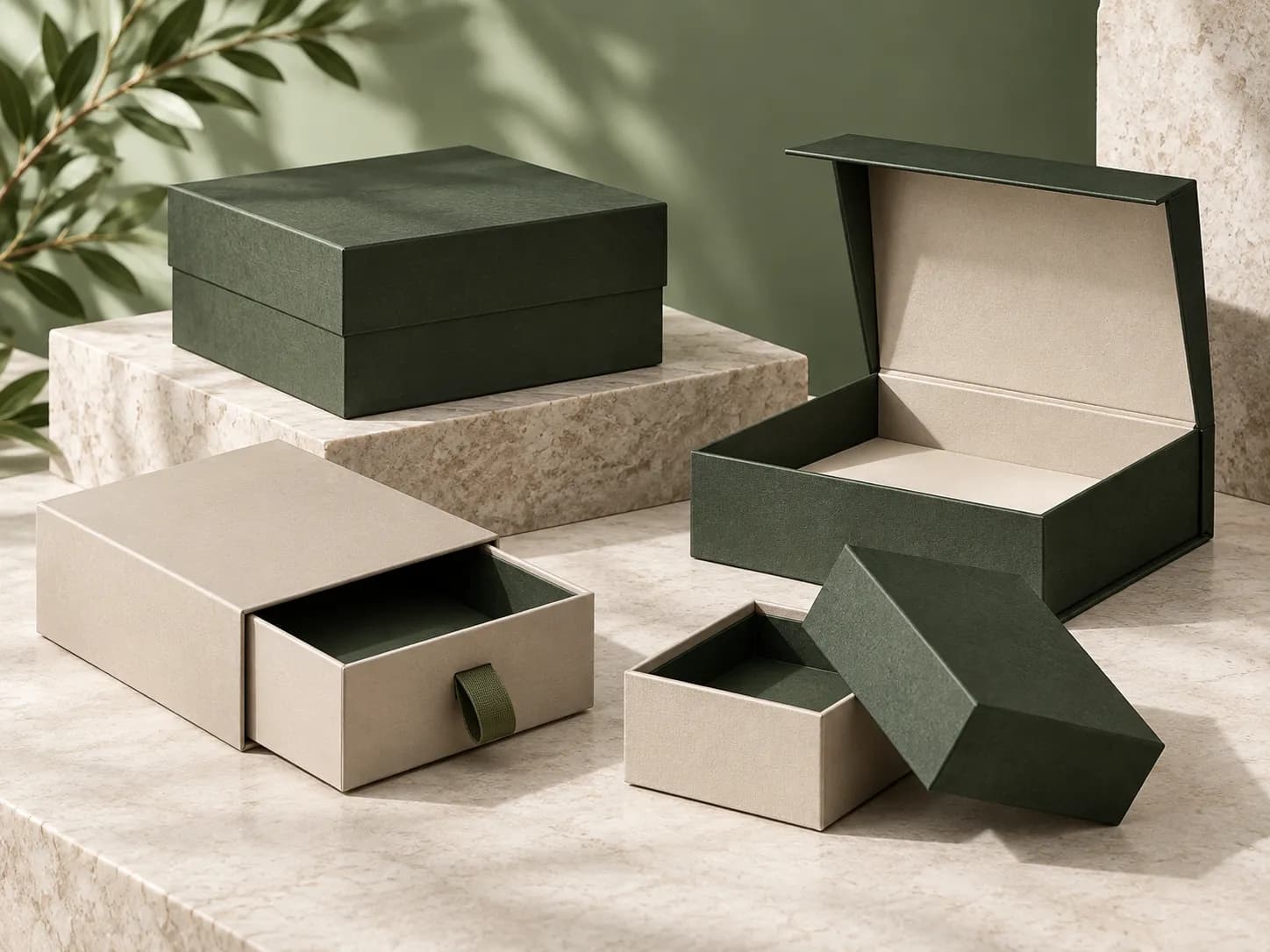
A folding carton is cut from a single sheet, glued at one seam and shipped flat. A rigid box is built from greyboard panels, wrapped in printed paper and largely assembled by hand. They are different products with different labor content, and the gap between them is wider than any other choice you will make. If you have not settled this yet, start with rigid boxes vs folding cartons.
2. Size
Packaging is bought as board area, and board area grows quickly with dimensions. A box an inch larger in every direction uses noticeably more material, fits fewer up on the press sheet, and takes more room on a pallet and in a trailer. Oversizing is the most common avoidable cost in packaging — and it carries a second penalty in shipping, which dimensional weight charges by volume rather than actual weight.
3. Quantity
Covered in detail in custom box pricing by quantity. The short version: the setup share per box falls as the run grows, steeply at first and then less and less.
4. Board and print
The material sets the base cost per square inch and how well it takes print. SBS gives a clean white printing surface, kraft an unbleached natural one, corrugated the strength to survive a courier. Print method matters too: see digital vs offset printing.
5. Finishes
Each finish is a production step with its own setup and its own pass through a machine. Foil stamping and embossing need their own dies. Spot UV needs its own artwork layer. Lamination is usually the least expensive way to change how a box feels. Finishes are where a specification quietly gets expensive, one reasonable-sounding addition at a time.
6. Inserts
An insert is effectively a second product inside the first, with its own material, its own die and its own assembly labor. It is often the right call — see custom inserts for bulk orders — but it should be priced as a decision, not assumed.
Starting at 50 and scaling from there
Custom Boxez produces from 50 boxes, which is genuinely useful for a first run, a sample batch for a retail meeting or a limited edition. It is worth being clear-eyed about what that means: at 50 units, the setup work is divided across 50 boxes, so the unit cost is at its highest point on the curve. That is not a penalty, it is arithmetic.
The practical approach is to treat the first small run as what it is — a way to hold the real thing, check color and fit, and put it in front of a customer or a buyer — and then plan the economics around the quantity you expect to be ordering once the product is selling. How to scale packaging from 100 to 10,000 covers what changes on the way up.
What to send to get an accurate quote
A quote is only as good as the brief behind it. These are the inputs that let a supplier price the job properly rather than hedging:
- Internal dimensions — length x width x depth of the space the product needs, not the outside of a box you already have. See how to measure your product.
- Product weight and how many units go in one box.
- Construction, if you know it, or a description of how the box will be opened, displayed and shipped.
- Board and finish preferences, or a reference sample you like.
- Quantity — and, if you can, the quantity you expect to reorder.
- Artwork or a dieline, or simply your logo and a note that you need a dieline drawn.
- Delivery destination, because freight is part of the landed cost.
If you are collecting quotes from several suppliers, send all of them the same brief. How to compare packaging quotes explains why that matters more than it sounds, and what to put in a packaging RFQ gives you a template.
Mistakes that make a quote look cheaper than it is
- Comparing a quote with tooling to one without. If one supplier has absorbed the die and plates into the unit price and another has listed them separately, the totals are not comparable.
- Ignoring freight. A low unit price with the box shipped across the country can land higher than a slightly higher price shipped nearby.
- Not asking about overrun and underrun. Presses do not stop at exactly your number; the accepted tolerance should be on the quote.
- Forgetting the insert. A box quoted without the insert it will need is not a quote for your packaging.
- Treating a sample as a price indicator. A one-off sample is made a different way from a production run and tells you nothing about unit economics.
The short version
Cost is built from a fixed setup portion and a variable per-piece portion. Construction and size move the number most; quantity determines how thinly the setup is spread; board, print, finishes and inserts fill in the rest. Send a complete brief, ask for the split, and compare like with like.
When you are ready for a real number for your box, request a quote with your dimensions and quantity — or talk it through with Sophie first if you are still deciding on the construction.
Terms used in this guide
- Setup cost
- The fixed cost of preparing a job to run — plates, dies, press make-ready and prepress — incurred once per run regardless of quantity. It is why the unit cost of a custom box falls as the order gets larger.
- Unit cost
- The price of one finished box, being the setup cost spread across the run plus the per-piece cost of material, printing, finishing and assembly. The setup share shrinks as quantity rises, which is why unit cost drops at volume and then flattens.
- MOQ
- Minimum order quantity: the smallest number of units a supplier will produce for a given product in a single run. It exists because setup, tooling and press time are largely fixed regardless of how many pieces are produced.
- Dieline
- The flat technical drawing of a box before it is folded, showing every cut, crease, fold and glue area for that exact size and construction. Packaging artwork is built on the dieline supplied for the job — it cannot be drawn from dimensions alone.
- Caliper
- The thickness of a board, quoted in the US in points (pt), where one point is one thousandth of an inch. A 24pt board is 0.024 inches thick. Caliper is how paperboard is specified; GSM is a weight measure and not interchangeable with it.
Questions
Related questions.
Anything not covered here, put it in the notes on your quote and we will answer it directly.
Ask on your quoteWhy won't suppliers publish packaging prices?
Because a custom box does not exist until it is made to your specification. The cost depends on your dimensions, construction, board, print, finishes, quantity and delivery point. A published price would either be wrong for most jobs or so hedged that it was useless.
Is it cheaper to order a larger quantity?
The unit cost is lower, because the fixed setup work is divided across more boxes. Whether the total is worth committing to depends on how quickly you will use them, what storage costs you, and how confident you are that the artwork and dimensions are final.
Does a smaller box always cost less?
Usually, because it uses less board and more boxes fit on a press sheet and a pallet. The exception is a box so tight that it needs a more complex construction or a more expensive insert to protect the product.
What is tooling and do I pay for it again on a reorder?
Tooling is the physical die that cuts and creases your box, plus any dies for foil or embossing. It is made for one specific size and structure. Reordering the same box unchanged generally avoids remaking it; changing the dimensions means new tooling.
How much does artwork affect the price?
Print-ready artwork supplied on the correct dieline costs nothing extra to process. Artwork that has to be rebuilt, separated or corrected adds prepress time. The number of ink colors and the finishes you specify affect cost far more than the design itself.
Keep reading
Related guides.
Packaging covered in this guide
Put it into a quote.
Start here
Send us your dimensions. We’ll send back a box.
Or talk to a packaging specialist: (209) 444-0744